
The Chimpanzee AGI Paradox
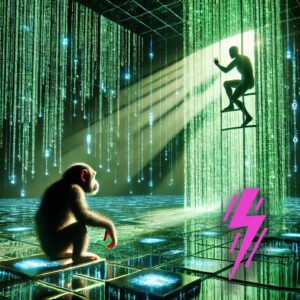
My first introduction to the question of AI came through the concept of the Turing Test, popularized by the book The Most Human Human. Every year, researchers conduct conversations via text to see if humans can distinguish AI from real people. In our current media landscape, headlines about Artificial General Intelligence (AGI) appear almost daily. Yet I believe we’ll never witness a single, definitive moment when we suddenly say, “Yes, we have AGI!”—because humans may never fully agree on what “human-like intelligence” even means.
To illustrate this, consider a chimpanzee observing humans climbing in its habitat. Over time, the chimp might see us gradually improve our climbing techniques. Yet from the chimp’s perspective, we will always move and think differently—never quite achieving “chimp-ness.” I call this the Chimpanzee AGI Dilemma: we want to see a computer “think like a human,” but our own uniquely human form of cognition isn’t something that can be perfectly replicated.
What is happening—and will continue to happen—is AI becoming better than humans at specific tasks. Years ago, we saw AI surpass human chess abilities. Now AI can draft emails more efficiently than we can. In the future, it will outperform us in many of the jobs we do today. However, it’s unlikely we’ll ever unanimously conclude that a machine truly matches or exceeds our innate general intelligence.
At MindTrack.AI, we aim to steer AI in a more human-centric direction. As AI grows more powerful, it will solve complex scientific problems that we humans benefit from but may never fully understand. Our goal is to bring AI down to a human level—to model the way our brains think—so that AI can serve as a mentor or coach. By combining human insight with incredibly powerful AI, we hope to maximize each individual’s potential and enhance the human experience.